
AI Agents & Cybersecurity

Article written by: Neel Ramachandran
What is an AI Agent?
An AI Agent is a software program that can observe its environment, make decisions based on those observations, and take actions to achieve a specific objective. Unlike traditional software that follows rigid, pre-programmed rules, AI agents are adaptive. They can learn from new data, adjust their strategies over time, and operate with a degree of independence.
In cybersecurity, the “environment” an AI agent observes might include network traffic, system logs, user behavior, application activity. Based on this information, the agent can decide whether something is normal or suspicious.
What makes AI agents especially powerful is their ability to operate continuously and at scale. While human analysts have limitations, AI agents can monitor multiple systems simultaneously.
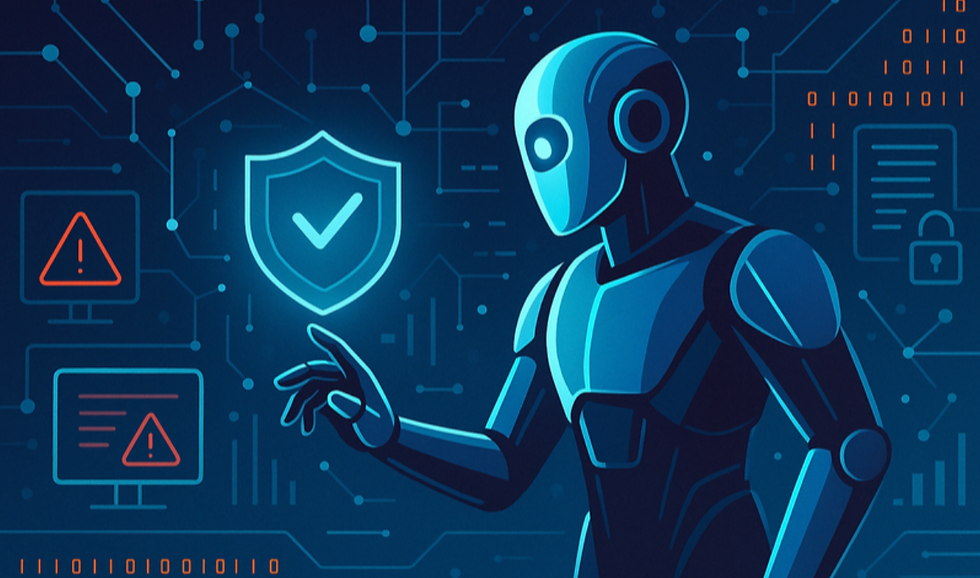
How AI Agents Can Defend Systems
AI agents are increasingly being used as a core component of modern cybersecurity defenses. One of their primary strengths is continuous monitoring. AI agents can constantly scan network traffic, system logs,and endpoint activity to detect anomalies.
Another advantage is task decomposition. AI agents can break down complex defensive tasks into smaller actions. For example if suspicious behavior is detected, one agent might analyze the threat, another might block a malicious IP address, and a third might isolate an affected machine. This process allows for faster, more precise responses.
How AI Agents Can Be Used by Attackers
While AI agents offer significant defensive benefits, they also introduce new risks. Attackers can build malicious AI agents designed to automate and optimize cyberattacks.

One of the most dangerous aspects of offensive AI agents is their ability to break down attacks using multiple agents. This can coordinate attacks across different systems and overwhelm defenses. AI agents can also be used to generate convincing phishing emails, automate social engineering campaigns, and discover bugs in code.
Works Cited
IBM. “What Is AI Agent Security?” IBM Think, https://www.ibm.com/think/topics/ai-agent-security. Accessed 22 Feb. 2026.
Anthropic. “Disrupting AI Espionage.” Anthropic News, https://www.anthropic.com/news/disrupting-AI-espionage. Accessed 22 Feb. 2026.
Google Cloud. “How Google Does It: Building AI Agents for Cybersecurity Defense.” Google Cloud, https://cloud.google.com/transform/how-google-does-it-building-ai-agents-cybersecurity-defense. Accessed 22 Feb. 2026.
Palo Alto Networks. “What Is Agentic AI Security?” Cyberpedia, https://www.paloaltonetworks.com/cyberpedia/what-is-agentic-ai-security. Accessed 22 Feb. 2026.
Security.com. “AI Agent Attacks.” Threat Intelligence, https://www.security.com/threat-intelligence/ai-agent-attacks. Accessed 22 Feb. 2026.


Comments