
AI In Schools: Yay or Nay?
- Jia Fletcher

- Nov 29, 2025
- 3 min read
Article written by: Jia Fletcher
Article designed by: Jia Fletcher and Natasha Gumpula
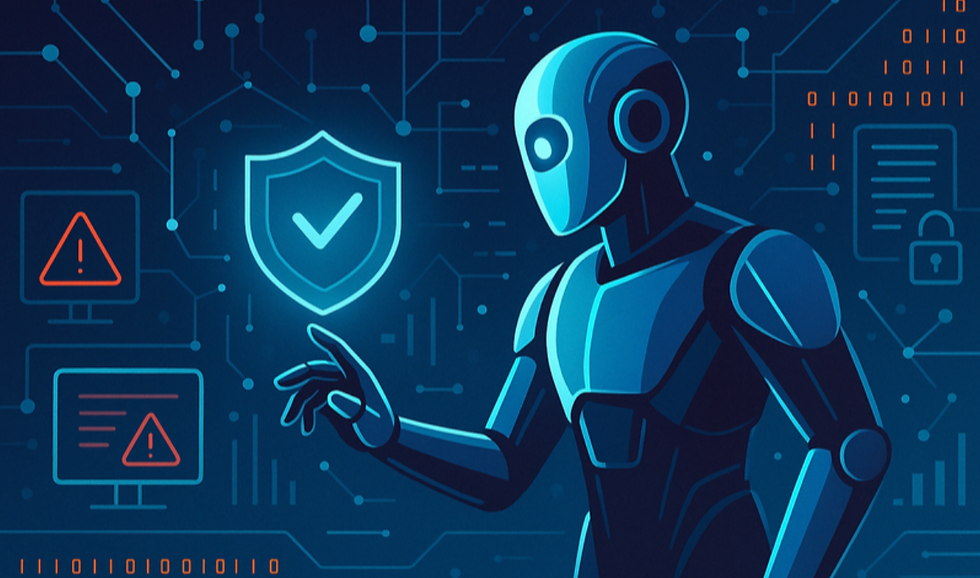
AI in schools has been a hot topic, especially in the past few years. AI has taken over sectors like healthcare and finance–and our school systems seem to be next. At first, AI was shunned from schools due to its manipulation as a cheating device. However, it’s now starting to become more widely accepted, seen as a tool to help both students and teachers alike for a better learning experience. There are still concerns about cheating/plagiarism becoming more common with AI, which poses a crucial question for us: should AI be implemented and accepted in schools?

(Image from Intelivita)
The Pros
Let’s first take a look at how AI can be beneficial in schools:
Easier research: AI models–like ChatGPT or Google’s AI Mode–make researching a lot easier for students, as it quickly gathers information from many resources and compiles it into an easy-to-understand format (and students can even use AI to simplify things, like a complex and long study they want to learn more about).
Study helper/tutor: AI can help students when studying for exams/assignments. Students can ask the AI model to solve problems for them (with explanations), or even teach them a topic they’re struggling with. It can help improve students' grades in this manner. (Image from EdWeek)

Lesson plan creation: Teachers may also benefit from having AI available to them, as it can be used to refine, edit, and create lesson plans. This reduces their workload and can allow them to spend more time engaging with and helping students.
Inclusivity: AI can help make learning more personalized for students with different abilities. It can adjust and understand students’ learning patterns/methods in order to provide them with a better educational experience (as opposed to teachers, who usually will stick to one teaching style).
The Cons
While these advantages definitely make AI a useful tool, there’s also many consequences/disadvantages of its presence in schools:
Cheating: AI poses cheating concerns, as many students may use it in order to do their work for them. With a simple command, they can have an essay written for them in seconds. Academic dishonesty is becoming a growing problem due to AI. (Image from eLearning Industry)

Reduced critical thinking skills: Students are becoming much more dependent on AI in order to get their work done, do research, etc. This dependency is alarming, as students are lacking in critical thinking skills due to relying on AI for many things. It poses concerns for students’ performance on tests and their overall academic abilities as they grow up.
Inaccuracy: Put simply, AI is not always right. If students rely on AI for tutoring and/or researching, they may encounter mistakes (that wouldn’t have been present in a video or research article, for example) and not even notice it! AI commonly makes mistakes and it cannot be a student’s only resource to learn.
Now What?
So what’s the answer to our question? Well…it’s complex. AI has its advantages and disadvantages. If students are properly educated on how to use AI in moderation, along with proper regulation and monitoring (especially for cheating incidents), AI can be an extremely beneficial tool for schools. All we need is balance.
Works Cited
Admin, CRPE. “Ai Is Coming to U.S. Classrooms, but Who Will Benefit?” Center on Reinventing Public Education, 27 Aug. 2025, crpe.org/ai-is-coming-to-u-s-classrooms-but-who-will-benefit/.
Administrator. “Ai in Education: 39 Examples.” University of San Diego Online Degrees, 27 May 2025, onlinedegrees.sandiego.edu/artificial-intelligence-education/.
Bhatt, Tuhin. “Ai in Education: Uses, Benefits, Examples & More.” Intelivita, 9 May 2024, www.intelivita.com/blog/ai-in-education/.
Johnson, Alyssa. “5 Ways AI Is Changing the Education Industry.” eLearning Industry, 25 Oct. 2023, elearningindustry.com/ai-is-changing-the-education-industry-5-ways.
Kumar, Naveen, and About The Author Naveen Kumar Naveen Kumar is a Data and Statistical expert at DemandSage. With a strong foundation in data analysis. “70 AI in Education Statistics & Trends (2025).” DemandSage, 11 Aug. 2025, www.demandsage.com/ai-in-education-statistics/.
“Negative Effects of Artificial Intelligence in Education.” Negative Effects of Artificial Intelligence in Education, www.mobileguardian.com/blog/negative-effects-of-artificial-intelligence-in-education. Accessed 15 Oct. 2025.
Schwartz, Sarah. “Can Ai Tutor Students? Why It’s Unlikely to Take over the Job Entirely.” Education Week, Education Week, 24 Oct. 2024, www.edweek.org/technology/can-ai-tutor-students-why-its-unlikely-to-take-over-the-job-entirely/2023/05.


Comments