
Cybersecurity in Your Wallet: Why Tap-to-Pay is Safer Than Swiping Cards
- Iyithihya Prakasan

- 3 days ago
- 3 min read
Article written by: Iyithihya Prakasan
Article designed by: Iyithihya Prakasan & Sanvi Desai
Cybersecurity is now extending out of computers and passwords and into our wallets in the new digital era. Whether you swipe, insert, or tap, the payment option you select in any store grants certain levels of security to your monetary information with every payment. Of these, tap-to-pay (contactless payment), has become one of the safest, as it poses very little risk of fraud, in comparison with conventional card swiping.
Getting to Know How Payments Work

When you swipe a card, the magnetic strip transmits your card information- the card number, and expiry date to the payment terminal. The problem? This data is fixed, that is, it is the same one in all transactions.
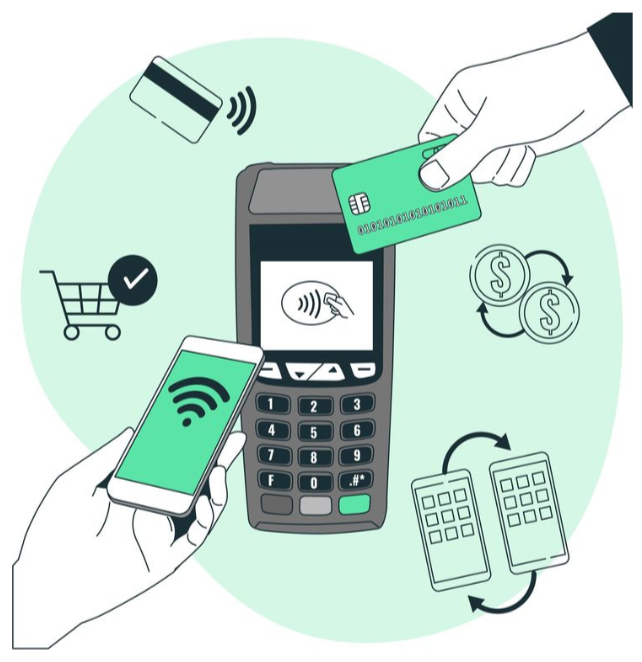
Conversely, tap-to-pay is technology implementation (such as Near Field Communication (NFC)) enabling the transfer of payment information wirelessly in a very limited area.
Image from Vecteezy
However, the actual difference is in the protection of the data.
Tokenization: Your Actual Card Number Is Hidden
Tap-to-pay services make use of a technology referred to as tokenization. Likewise, a system will send you a temporary, randomized token in place of your real card number.

None of your actual card details are shown by the merchant.
Even if data is intercepted, it’s useless
Your real account remains safe based on secure banking systems.
This renders it much more difficult to secure usable information by hackers.
Image from Vecteezy
Dynamic Cryptograms: Protection by one-time security code
Each transaction made by tap is accompanied by a cryptogram (cryptogram) that is unique and a single instance in nature.
This code is only valid to that particular transaction.
It is not re-usable or copyable.
Even data that have been intercepted get invalidated immediately.
Swiping on the other hand transmits the reusable data each and every time-criminals can easily copy cards.
Defenses against Skimming Attacks
One of the most typical types of payment frauds is card skimming. With the help of criminals, card readers are installed to steal information when people swipe their cards.
Image from Feeding Trends
Tap-to-pay practically removes this risk:
None of the physical interaction with a machine.
No gap to skimming devices.
None of the magnetic strip data is exposed.
Since your card does not leave your hand, the risk of fraud is brought to minimal.
Short-range communications are more secure
The tap-to-pay has a very limited distance (approximately 4 cm).
This means:
Signals cannot be easily intercepted by a hacker at great distance.
The payment is only made once your card is pressured outside the terminal.
Such a requirement of proximity serves as another form of protection.
Secured than a Swipe-on and even as much as Chip Cards

Advanced encryption is used in both tap-to-pay systems and the chip-based systems,
however, swipe based transactions are now viewed as archaic and unsafe.
Image from Pinterest
Swipe (static data) = Easily copied.
Tap/Chip > Dynamic encrypt data > Very difficult to reuse.
Due to this reason, the payment industry is slowly eliminating the use of the magnetic stripes.
Do You Find any Risks?
Although tap-to-pay is far less dangerous, there are no systems that can be considered absolutely safe.
Other attack types such as relay attack are rare.
Leaving your card will permit small transactions not authorized (based on limits).
Nevertheless, these threats are insignificant in reflection of the prevalent weaknesses of swiping.

Cybersecurity has moved past gadgets- it is now implemented in day-to-day functions such as visiting a coffee shop. Tap-to-pay has become a significant improvement in terms of security as well in that it brings multiple benefits of tokenization, encryption, and physical protection.
Image from Vecteezy
In simple terms:
There is data leaking when it comes to swiping. Tapping protects it.
Because online payments are becoming a more popular phenomenon, the decision to use safe plans such as tap-to-pay is among the least complicated means of protecting your financial self-image.
Works Cited
Kagan, Julia. “What Is a Contactless Credit Card?” Forbes Advisor,https://www.forbes.com/advisor/credit-cards/contactless-credit-cards/.
Legal Clarity. “Is Tap to Pay Safer? Tokenization and Security Explained.” LegalClarity,https://legalclarity.org/is-tap-to-pay-safer-security-and-liability-explained/.
Legal Clarity. “Is Tapping a Credit Card Safer Than Swiping? Fraud Risk Explained.” LegalClarity,https://legalclarity.org/is-tapping-a-credit-card-safer-than-swiping-fraud-risk/.
Legal Clarity. “Does Tap-to-Pay Prevent Skimming? The Real Risks.” LegalClarity,https://legalclarity.org/does-tap-to-pay-prevent-skimming-the-real-risks/.
Legal Clarity. “Does Tap-to-Pay Prevent Skimming Risks and Gaps?” LegalClarity,https://legalclarity.org/does-tap-to-pay-prevent-skimming-risks-and-gaps/.


Comments