
Why Cybersecurity might be a future-proof career path
- Tanisha Arora
- Dec 12, 2025
- 2 min read
Article written by: Tanisha Arora
Article designed by: Tanisha Arora & Sanvi Desai
“AI will steal all our jobs!” Now that’s a common phrase going around these past couple of years. And honestly, it’s a phrase that’s pretty believable at its face value. Artificial Intelligence has been developing rapidly in almost every field imaginable ranging from medicine and engineering to art and music. Everyday there’s a new article on CNN regarding innovations in the field, some that are almost life changing. Artificial intelligence has brought a lot of positives to mankind and will only continue to expand in the future. But with all good things, there come a good amount of negatives.
According to the National Cyber Security Centre, with the implementation of AI come new risks such as “prompt injection attacks” and “data poisoning attacks,” both of which negatively harm users. These are just a couple of examples of the cyber risks of AI—risks that need to be addressed with utmost urgency. And because of this urgent demand, one field has been growing rapidly: Cybersecurity.
Cybersecurity is experiencing an explosive growth, with the demand for professionals in the field unyielding. With a global shortage of 3.4 million cybersecurity professionals and projected job growth rates of 35%, cybersecurity is one of the most desirable and stable career pathways (NIST). The chart below shows the projected growth of the cybersecurity market in this decade, which is logarithmically growing year by year.

Image from grandviewresearch.com
The visual by Grand View Research also shows that there are a variety of sectors under the overarching field of cybersecurity, specializations that might seem surprising or odd. According to the cybersecurity company SSH Communications Security, some of these sectors include the following:
Energy sector
Healthcare & Pharmaceuticals
Information Technology & Telecommunications
Defence & Aerospace
Transportation & Logistics
Water & Wastewater Systems
Food & Agriculture
Banking & Financial Services
Manufacturing & Industrial Base
Chemical Industry
While these sectors are vastly different from one another, they share one common categorization: critical infrastructure. These critical sectors are “vital to national security, economic stability, public health, and society’s overall function” and as such, require strong cyber protection measures.

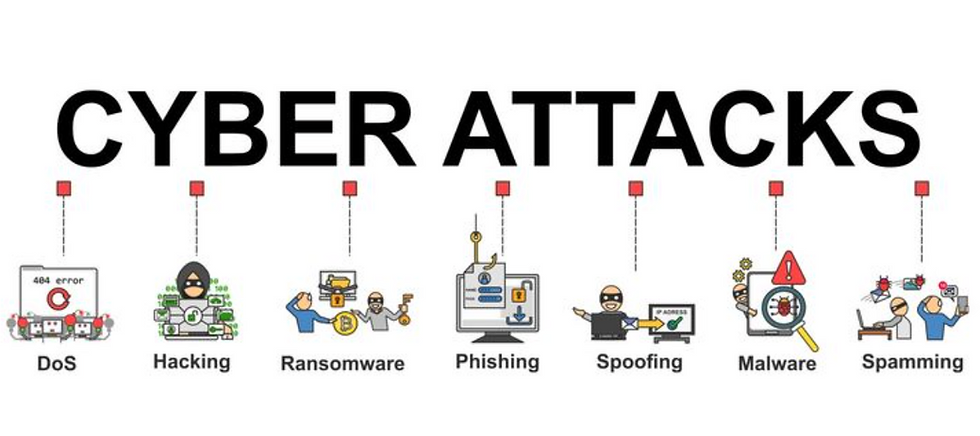
Image by valentisinc.com
Now that we’ve gained a better understanding of the importance of cybersecurity, it is important to understand why these jobs can not be replaced with artificial intelligence. Artificial intelligence has the capabilities to perform automated tasks and pattern detection, however, more times than not, it’s not enough. Artificial intelligence lacks the intuition and ethical understanding needed to excel in the field because rarely are two cyber attacks the same. Human professionals are necessary in this field more than any other because only we can respond with creativity and ethical intuition.
Works Cited
“AI and Cyber Security: What You Need to Know.” NCSC, www.ncsc.gov.uk/guidance/ai-and-cyber-security-what-you-need-to-know. Accessed 23 Nov. 2025.
Nardone, Massimo. “The Role of Cybersecurity in the Critical Industrial Sectors .” SSH, SSH Communications Security, 14 Mar. 2025, www.ssh.com/blog/the-role-of-cybersecurity-in-the-critical-industrial-sectors.
Nist.Gov/Nice Updated June 2023 Cybersecurity Workforce Demand Global, www.nist.gov/system/files/documents/2023/06/05/NICE%20FactSheet Workforce%20DemandFinal_20211202.pdf. Accessed 23 Nov. 2025.


Comments